
Why Are There So Many Lawyer Billboards? Follow the Money.
Drive down almost any interstate these days and you may notice something.
Lawyers. Lots and lots of lawyers.
“INJURED?”
“CRASH?”
“WE WON $10 MILLION.”
Some of them have catchy phone numbers. Some have nicknames. Some appear every few miles until you begin to wonder whether there are actually more personal injury lawyers than gas stations.
There is a reason for it.
Those billboards aren’t really about practicing law.
They are about acquiring customers.
In modern marketing language, they are lead generation.
And apparently, the leads are valuable enough to justify spending an extraordinary amount of money to get them.
One industry estimate put total U.S. legal-services advertising at more than $2.5 billion in 2024, covering television, radio, digital advertising, print and outdoor advertising. Morgan & Morgan alone was estimated to have spent about $218 million advertising legal services that year. (ATRA)
You don’t spend $218 million advertising something unless acquiring the next customer can be very profitable.
What Happens to the Lead?
This is where things get a little more complicated than I originally thought.
It would be tempting to assume that the giant firms advertising everywhere simply collect accident leads and sell them to local lawyers.
Sometimes cases are referred to other attorneys or handled through co-counsel arrangements. Large firms also have lawyers and offices in multiple jurisdictions and handle plenty of cases themselves.
And the legal profession has rules surrounding referrals that don’t exist in most ordinary businesses.
The American Bar Association’s Model Rules distinguish between paying legitimate advertising costs and simply paying someone for recommending a lawyer. Connecticut has similar restrictions, while also allowing certain qualified referral and lawyer-matching arrangements. (American Bar Association)
So calling the whole thing a giant lead-selling operation would be unfair.
Calling it a highly sophisticated customer-acquisition business, however, seems entirely accurate.
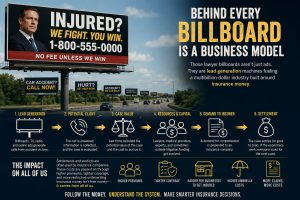
A billboard generates a phone call.
The phone call generates a potential case.
The case has an expected value.
And once businesses begin calculating the lifetime value of a customer against the cost of acquiring that customer, you’re no longer looking at the sleepy neighborhood law practice most of us grew up with.
You’re looking at an industry.
And What Is the Product?
Here’s the part that interests me as an insurance agent.
In many personal-injury cases, the ultimate source of the settlement isn’t the driver who caused the accident.
It’s an insurance company.
Auto insurance.
Commercial liability insurance.
Umbrella insurance.
Professional liability insurance.
Excess liability insurance.
In other words, a substantial portion of the money everyone is competing for ultimately comes out of the insurance system.
And investors have noticed.
Third-party litigation funding has grown into a business of its own. Under these arrangements, outside investors provide capital connected to lawsuits in exchange for a potential financial return. Swiss Re has specifically identified third-party litigation funding and rising litigation costs as factors contributing to higher U.S. liability claim costs. (Swiss Re)
There is even outside investment moving closer to the law firms themselves. The Financial Times recently reported that some personal-injury firms have obtained outside investment using management-service-company structures, while larger private-equity firms are exploring ways of investing in legal businesses without violating restrictions on nonlawyer ownership of law firms. (Financial Times)
That doesn’t mean Wall Street owns every lawyer on a billboard.
It does mean that capital increasingly sees litigation as an investment opportunity.
And that is worth paying attention to.
Follow the Economics
Consider the financial chain.
A law firm spends money advertising for accident victims.
A prospective client calls.
The firm evaluates the potential claim.
Lawyers, medical providers, experts and sometimes outside litigation capital become involved.
A demand is eventually presented to an insurance company.
The claim settles or goes to trial.
If the economics work, everyone goes looking for the next case.
That creates an unusual marketplace because the person buying the legal service isn’t necessarily the person ultimately funding the economic transaction.
Very often, an insurer is.
And ultimately an insurance company’s claim payments become part of the loss experience used to determine what insurance costs everyone else.
That’s why people in the insurance industry talk so much about social inflation — increases in liability claim costs beyond ordinary economic inflation. Swiss Re has concluded that litigation costs have become a significant driver of U.S. liability claims and expects those pressures to continue. (Swiss Re)
There are obviously legitimate lawsuits.
People injured through someone else’s negligence deserve compensation.
Insurance companies can deny claims, dispute damages and make mistakes. Lawyers play an essential role in giving injured people the ability to challenge a large corporation with far greater resources.
That’s not the point.
The point is what happens when an entire financial ecosystem develops around finding, financing and maximizing claims.
Insurance Money Isn’t Free Money
This is the part consumers rarely see.
Insurance companies don’t manufacture money.
The dollars used to pay claims ultimately come from premiums paid by millions of homeowners, drivers and businesses.
If liability losses rise persistently, insurers eventually respond.
Premiums go up.
Umbrella underwriting gets tighter.
Businesses see higher liability costs.
Certain risks become harder to insure.
Coverage limits become more expensive.
Insurance companies become more aggressive about underwriting and claims.
And then consumers understandably ask:
Why has insurance become so expensive?
There isn’t one answer.
Cars cost more to repair. Medical care costs more. Weather losses have risen. Reinsurance is expensive. Construction costs have increased.
But litigation belongs in the conversation too.
Perhaps those endless lawyer billboards are a visible symptom of something much larger.
They tell us that somebody has calculated the economics.
An accident victim is worth acquiring.
A lawsuit is worth financing.
An insurance policy represents available capital.
And increasingly, sophisticated businesses and investors are competing for a piece of it.
So the next time you pass the fifth personal-injury billboard in ten miles, don’t just look at the lawyer.
Follow the money behind the billboard.
Because there’s a reason everybody wants that phone to ring.
I especially like the distinction between “insurance money” and “insurance-company money.” The latter sounds like it belongs to some giant corporation; the former makes the point that the pool ultimately comes from everybody’s premiums. That gives this piece a much stronger Page Insurance angle without turning it into an anti-lawyer rant.